Could Montessori Transform Early Childhood Education?
June 21, 2024

For those of us with children in a Montessori program, we understand fully just how powerful this approach to education can be. Not only do children have an advantage academically, but the whole child’s growth and development is valued and nurtured. Additionally, ripples of the work with children positively affect the greater community.


While Montessori’s early roots were in serving children of low-income families in Rome, over the past hundred years availability of Montessori schools has shifted to mainly affluent communities. While there are certainly public Montessori offerings, the vast majority are only available to middle- and upper-income families who are able to pay tuition at independent schools.


Recent research highlights the ability of a high-fidelity Montessori program to positively impact diverse communities. In areas that tend to be more racially, culturally, and socio-economically diverse, Montessori opportunities are rare, but could potentially provide a substantial positive impact. 


One case study published this past spring was written by Mary D. Burbank, Melissa M. Goldsmith, and Koeun Park (all of the University of Utah), and Jennifer Spikner of Chicago, Illinois. Entitled Montessori Education and a Neighborhood School: A Case Study of Two Early Childhood Education Classrooms, it details the transformation of two classrooms within an urban school.


The study was guided by Project SYNC (Systems, Yolked through Nuanced Collaboration) and the work of various stakeholders. Those involved in the project included a university, the public school district, an established elementary school, and a local private Montessori school. Each played a specific but different role in the implementation of the project.


In short, a public elementary school of over 500 students was already offering full-day preschool and kindergarten. It committed to transforming 2 of its 4 early childhood classrooms into fully implemented Montessori classrooms, along with two teachers that volunteered to become trained and certified. With the assistance of a para-educator in each classroom and support from a local private Montessori school, the case study covered both the planning and implementation years.


It is important to note that the elementary school already had a deep commitment to serving the diverse community in which it stood, including a focus on social justice and trauma-informed practices. The goal of the school was not only to educate the children, but to serve the families and community as whole.


The authors of the study noted several important motivations for the project’s existence:


“Montessori education offers an educational experience that creates opportunities for students to engage in learning opportunities that are self-directed, exploratory, and based upon individual learners. As such, Montessori education may be thought of as culturally responsive, as it is based upon classroom learners.”


“...the flexibility of Montessori experiences allows students, particularly students of color, to express themselves and be themselves without assimilating to the norm within more-typical classroom settings.”


As stated before, the teachers became fully credentialed. Both classrooms were outfitted with traditional Montessori materials and a 2½ hour work period was honored each morning. All family participants were voluntary, and while the demand met the need the first year, the success of the program led to waiting lists during subsequent years.


Evaluation of this case study included opinions of the stakeholders, classroom observations, and teacher participant attitudes.


During the planning year, six of the stakeholders participated in in-depth interviews. While most were not overly familiar with Montessori education, all were excited by the prospect and inspired to bring new opportunities to an underserved community. 


During the course of the implementation phase, a number of data points were collected. Six stakeholders participated in a survey, the two teachers responded to open-ended questions, and 34-40 students were observed on numerous occasions. 


The responses were overwhelmingly positive.


Data showed:

  • Family engagement had increased.
  • Montessori had a positive influence on the children’s learning.
  • The model had been successfully implemented within the larger conventional school.
  • Over time, students were able to more clearly express their individual selves.
  • Montessori grace and courtesy lessons helped build relationships within the classroom.


Moving forward, it would be interesting to see if this type of project could continue on a long-term basis and/or be replicated widely. Funding and support are typically the two most distinctive barriers. Those interested in creating similar opportunities for students in diverse communities might benefit from implementing a braided funding approach. A committee of supporters with the ability to educate stakeholders on the benefits of Montessori education would also be important for buy-in.
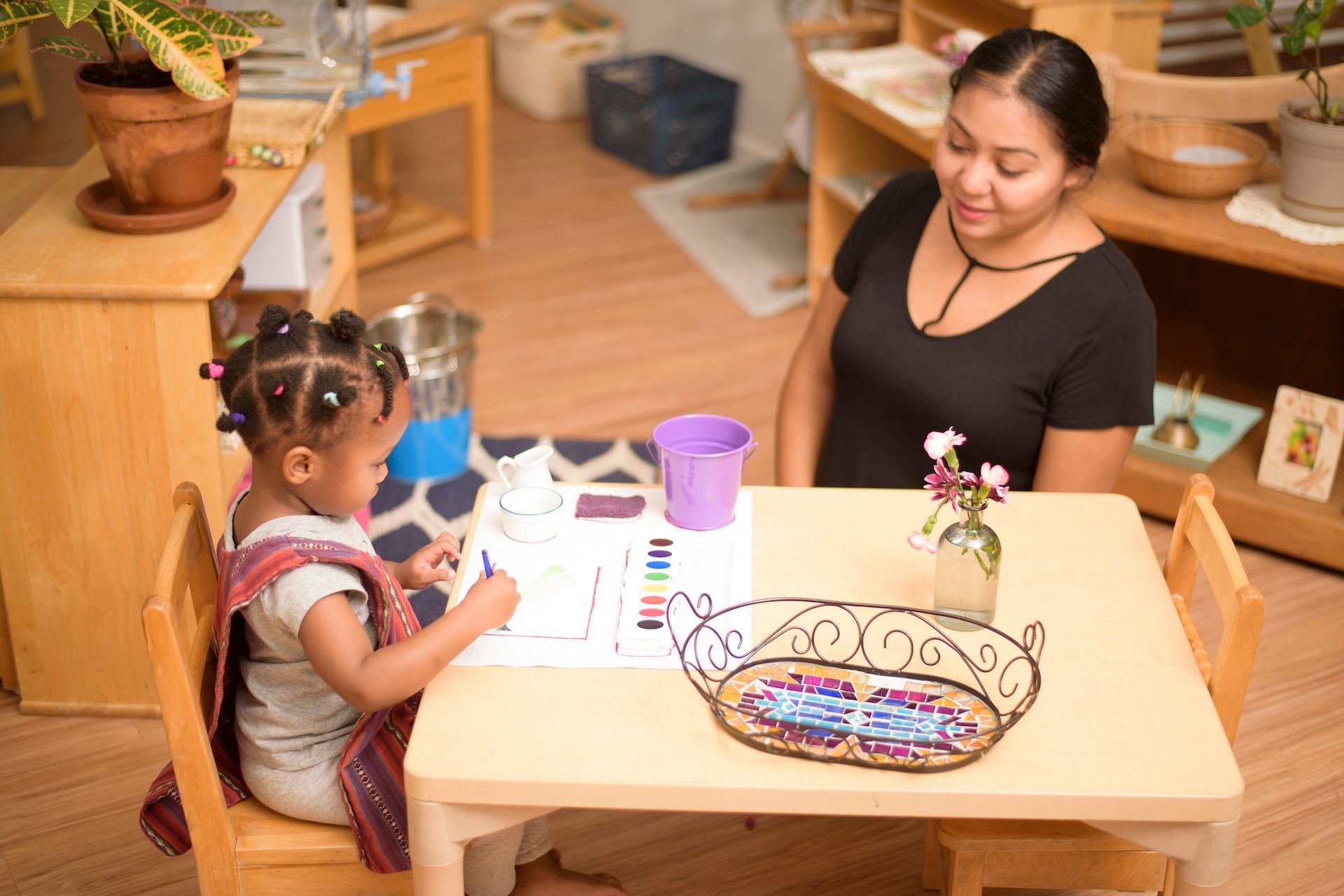
Child painting at a table in a cozy home, focused on colorful artwork.
By Gabriela León June 16, 2026
With the slower pace of summer, more time at home and outdoors, and more unstructured hours to fill, it’s a perfect time to pull art supplies out fo the closet, cover tables with paper, and unleash some creative energy! What happens in these creative moments matters more than most of us realize. And how we respond to what children make matters just as much as the making itself. The Process Is the Point A foundational principle behind Montessori's approach to children's artmaking is that the process of making art is far more important than the product. This can be difficult for us to internalize, because the product is what we most often see. It’s not that we don’t care about our children’s experience. But the painting is what comes home. The drawing gets taped to the refrigerator. We get handed the collage at pickup. So it’s natural to focus on what is right in front of us. But it is the moments when children are deeply absorbed in moving paint across paper, pressing clay between their fingers, or scribbling long, looping lines with a crayon that something essential is happening. This is a deep form of creative expression and an outlet for feelings children may not yet have words for. Plus, children are developing visual-spatial skills, fine motor coordination, and the capacity for innovative thinking. During art-making, children are problem-solving in real time, making decisions about color, form, pressure, and space. And they are experiencing the deep satisfaction of following an internal creative impulse all the way through to its end. What Not to Say and What to Say Instead One of the most important things we can do to support young children's creative process is to be thoughtful in our comments. Even well-meaning responses can shift children's focus from their own inner experience to an adult's reaction. Once that shift happens, children begin making art for the audience rather than for themselves. Comments like, "That's beautiful!" or "What is it?" or "Can you make one for Grandma?" are all, in different ways, asking children to produce something for someone else or to explain and justify what they've made. Neither of these supports genuine creative development. Instead, focus on objective, process-focused observations. For example, "I can see you used a lot of green and purple today," or "Your lines extend all the way to the edge of the paper," or "It looks like you really enjoyed making that." These responses acknowledge children's work without judging it, and they communicate that what they made matters, and what they experienced while making it also matters. Young children often cannot (and should not have to) explain their art. The experience of making art is enough. A Summer Opportunity: Freedom to Explore Summer is an ideal time to offer children a real variety of creative materials and the freedom to choose what calls to them. Different children will be drawn to different media, and what each child gets from a new experience will be entirely their own. Variety is important precisely because it sparks different kinds of interest and expression in different children. Here are some starting points for summer art exploration, appropriate for toddlers and young children: Offer crayons and large paper for open-ended scribbling and mark-making. It’s best to begin by offering large spaces before moving to smaller ones. Large paper means that children's bodies have room to move freely. Easel painting or watercolors offer the joy of color mixing and the experience of a brush moving across a surface. Play-dough and clay can satisfy children's deep need to manipulate, press, and build with their hands. Collage materials (paper scraps, leaves, fabric, natural objects) invite children to arrange and compose in ways that feel both free and purposeful. Chalk on pavement (or dark paper, if the weather isn’t cooperating) is especially magical outdoors on a summer morning. From a practical standpoint, it’s helpful to protect clothing and surfaces before beginning, so children can work freely without worry (theirs or ours!). Choose non-toxic materials, particularly for the youngest children who may still explore things with their mouths. And resist the urge to direct the outcome. Children who cover their paper entirely in black paint are not doing it wrong. They are doing exactly what they need to do. What to Do With What They Make Not every piece of art needs to be saved or displayed. Saving a selection of artwork from across the summer (early pieces, middle-of-summer pieces, late-summer pieces) can serve as a timeline or record of your children's creative development and a meaningful way to look back together at the end of the season. If there isn’t room to display selected pieces, a simple folder or large envelope can also work perfectly for this. When you look through the artwork together, let your child lead the conversation or simply look at it together without words. The goal is never gallery-ready products. The goal is children who trust their own creative impulses, who feel free to experiment and make a mess and start over, and who carry the confidence of someone who has been allowed to make things in their own way. Summer is long, and the canvas is wide! Let children fill it however best suits their needs! We'd love to hear how your family is spending the summer months. And we always love to share how we support creative exploration in our prepared environments in our school. Contact us to learn more!
Child sitting on a carpet, fastening a white sandal while wearing a floral top and mustard pants
By Gabriela León June 9, 2026
Summer has a rhythm that the school year rarely allows. Mornings without a clock ticking. Afternoons that stretch and meander. The unhurried pace of days that don't need to be anywhere quite so urgently. And tucked inside all of that spaciousness is one of the most valuable gifts the season can offer young children: time to do things for themselves. In Montessori, we don’t rush through the practical life activities that help children care for their own bodies: washing hands, dressing, brushing hair and teeth, wiping a nose, and putting shoes away. We don’t even think of these as chores because they are among the most important developmental work in our children’s early years. And summer, with its slower tempo, is the perfect season to lean into them. Independence Is the Destination and the Journey Dr. Montessori understood that, from the very first moments of life, children are moving toward independence. The newborn who moves toward the breast has already taken a first step. That milestone transforms the toddler who learns to walk: their hands are suddenly free, they can move toward or away from people and objects in their world, and they can begin actively shaping their own experience rather than merely absorbing it. Every act of self-care that children learn to do for themselves is another step along this path. Not because independence is about doing things alone, but because the child who can care for their own body develops a sense of genuine capability, a trust in themselves, and a growing understanding of who they are as unique human beings. As the Montessori principle goes: Help me to do it myself. Collaboration Before Independence One of the most important things to understand about supporting self-care in young children is that the path to independence moves through a collaborative process. Often, things go awry when we swing between getting caught up in instruction, resorting to doing something for them, or stepping back entirely before they are ready. The progression looks something like this: first, we do the activity with or for the child, using gentleness and narration, so the child is always a participant, even before they can act. "I'm going to put on your shirt. Let's put your arm through the sleeve." Gradually, the adult and child do the activity together. Eventually, the child begins to imitate, then to do it in their own way, imperfectly, slowly, and with deep satisfaction. This progression is not a straight line. There will be days when a child who has been dressing independently for weeks suddenly wants help again. This is entirely normal and simply calls for a gentle return to collaboration: "Let's do this together." Our goal is always to offer just enough support and no more. We want to find the balance between honoring children's need for assistance and protecting their emerging sense of capability. What Summer Makes Possible The school year, for all its richness, is often defined by time pressure. Mornings, especially, can become a sequence of things that need to happen faster than children can manage them independently. Shoes get put on by adults. Jackets get zipped by adults. Hair gets brushed quickly and without much ceremony. During the summer months, there is often more space to let a three-year-old button their own shirt, however long it takes. There is time to stand back and watch a toddler figure out how to pull on their own socks. There is room for the unhurried back-and-forth of teaching a child to wash their hands properly, step by step, at a sink they can actually reach. If we think of these moments as children’s real work, we can avoid getting caught up in the sense that the process isn’t efficient! This is a long-term game. Our children are building their abilities and their internal sense of capability. Practical Suggestions for the Summer Months Here are a few ideas for bringing the Montessori approach to self-care into your home this summer: Set up the environment for success. Small adjustments allow children to manage their own needs without regularly needing adult assistance. Perhaps place a step stool at the bathroom sink. Provide low hooks for towels and clothing. Create a low shelf for children to store their belongings. Choose clothing that supports independence. Elastic waistbands, velcro shoes, and loose-fitting shirts can be respectful of children's current physical abilities. Children who can dress themselves feel capable. Narrate without taking over. When a child is struggling with a button or a zipper, resist the impulse to fix it immediately. Try instead: "You're working hard on that. Would you like to try once more, or would you like some help?" This keeps the child in the driver's seat of their own experience. Begin with larger movements, then refine. Just as with any practical life work, self-care builds from the general to the specific. Children learn to pull a shirt over their head before they learn to fasten buttons. They learn to remove their shoes before they learn to tie them. Follow your child's current capacity and build from there. Move without talking; talk without moving. This Montessori principle helps us demonstrate a self-care activity most effectively. When showing a child how to wash their hands, do it slowly and silently, so the movement is fully visible. Then, separately, use words to name the steps. Children often find it difficult to simultaneously track our narration and demonstration. Self-Care Activities Worth Practicing This Summer Consider the range of self-care activities appropriate for our children. Do they include undressing and dressing, hand washing, brushing hair, brushing teeth, wiping the nose, and caring for shoes? What else would your child benefit from learning how to master? Your child can practice these skills gradually as part of the natural rhythm of daily life. There is no hurry. There is no single right timeline. What matters is the collaborative attitude that underlies each interaction. The adult and child are working together. We honor children's participation. Our goal is always to help children come to know what they are capable of. The Deeper Meaning Dr. Montessori was clear that the destination of this entire developmental arc, across all four planes of development, all the way to young adulthood, is a person who can provide for themselves, take responsibility for their own actions, plan for their own future, and perhaps even support others on their own path toward independence. It begins here with a small person pulling on their own socks or learning to wash their own hands, and in a summer that is long enough and slow enough to let them try. We hope your summer is full of these quiet, meaningful moments. If you would like to learn more about honoring children’s journey toward independence, please schedule a visit to our school!