

The Globe That Opens the World: How Montessori Geography Ignites Imagination
Gabriela León • July 7, 2026

Montessori geography materials help children explore the world through hands-on learning, imagination, and real-world discovery.

In seeking to understand the world, young children ask so many questions! The Montessori geography materials meet that curiosity with simple, beautiful objects that help children put the world into context.


As Dr. Montessori explains in Education for a New World, "Children are not able to follow long explanations, and need simple answers, where possible helped by some illustrative object, such as the globe to the child's quest in geography."


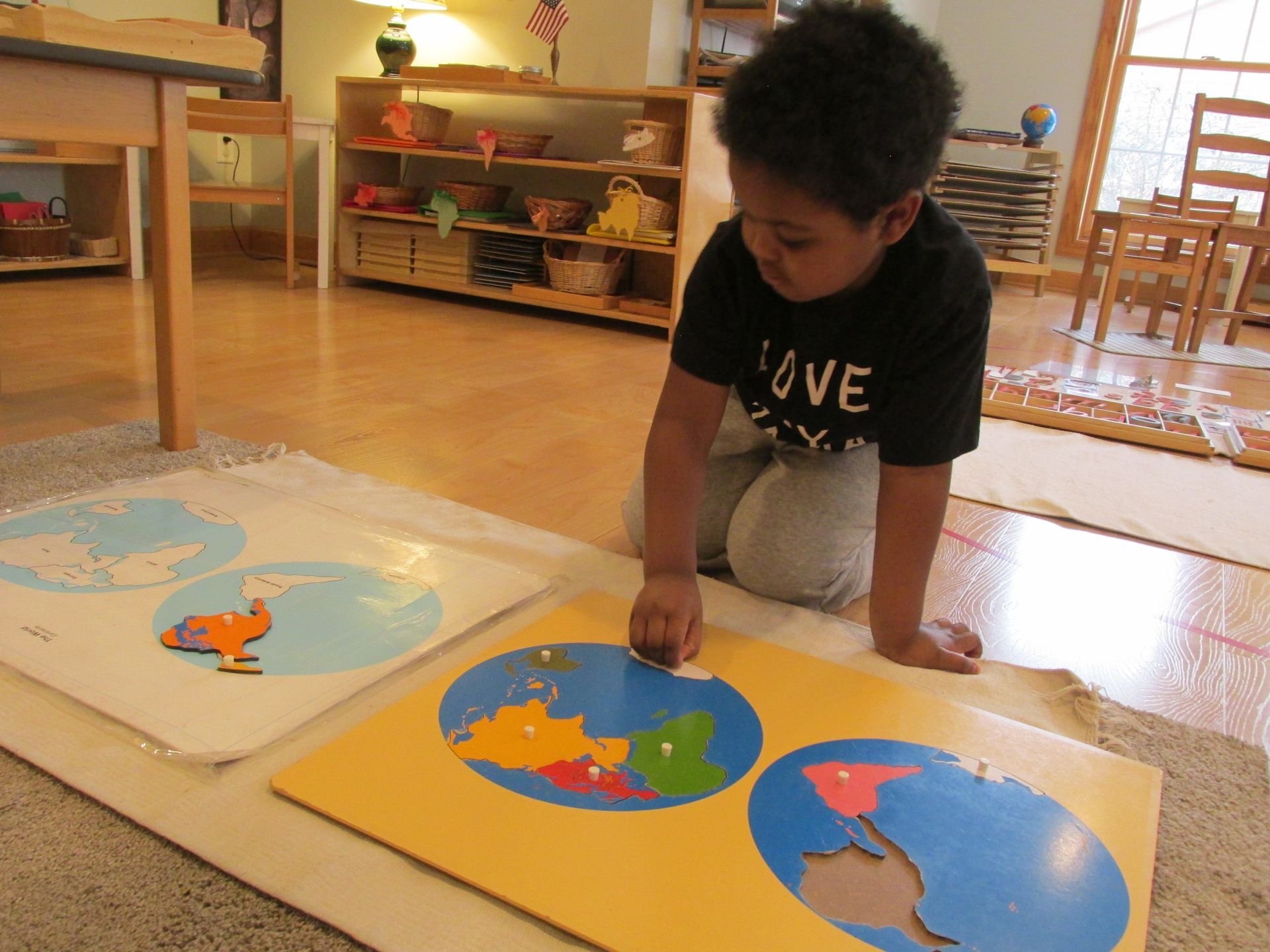
So our geography materials offer illustrative objects, such as a globe, puzzle maps, and trays of land and water forms. The results of offering children these real objects are often quietly extraordinary.


Real Things to Imagine


Dr. Montessori observed that young children have a remarkable and largely untapped capacity for imagination, but this capacity is often channeled in a limited way. As she wrote, "This strength of imagination in the child under six is usually expended on toys and fairy tales, but surely we can give him real things to imagine about, so putting him in more accurate relation with his environment."


Certainly, the study of geography provides the young child with tremendous opportunities to mentally explore seemingly new worlds: places full of different animals, homes, people, and landscapes unlike anything in their immediate experience.


Dr. Montessori shared a charming story that captures the Montessori approach to geography. A group of six-year-olds was gathered around a globe when a child not yet four years old ran up to see. Looking at the model of the earth, the little one suddenly understood something: "Is this the world? Now I understand how it is my uncle has gone three times round the world.” In that moment, the child could understand that the globe was only a model and that the real world was immense. In a single interaction with one simple material, a young child had made a conceptual leap from the concrete object in front of them to the vast reality it represented.


A Mind That Goes Beyond the Concrete


Young children are often underestimated in their capacity for abstract thought. Because they learn through their senses and their hands, we sometimes assume they can only grasp what is directly in front of them. Dr. Montessori pushed back on this firmly: "Is the child's mental horizon limited to what he sees? No. He has a type of mind that goes beyond the concrete. He has the great power of imagination."


The child who can imagine a fairy and a fairyland, as Dr. Montessori noted, has no difficulty imagining South America, or a distant mountain range, or a culture on the other side of the earth. What they need is something real and beautiful to anchor that imagination. The geography materials allow children to imagine aspects of the Earth and its features that they might not otherwise see or access. They can experience the land and water forms and learn the vocabulary of strait, isthmus, and peninsula. They can differentiate between the continents and begin to explore the rich differences of human cultures.


Learning Through the Hands


Like all Montessori materials, the geography materials for children ages three to six are designed to be touched, handled, and explored. As Dr. Montessori explains, "the child's mind can acquire culture at a much earlier age than is generally supposed, but his way of taking in knowledge is by certain kinds of activity which involve movement."


The land-and-water globe invites children to run their fingers across rough land and smooth water, building a sensory impression of the earth's surface that extends beyond a two-dimensional photo. The land and water forms allow children to pour water into trays with pre-shaped landforms, so they can experientially discover the physical differences between a peninsula and an isthmus, a cape and a bay. The puzzle maps offer children a satisfying, hands-on experience of lifting, rotating, and placing wooden continent pieces, and even distinguishing between countries and states. Children touch the shapes of the continents with their fingertips and name them as their own.


Through all of this, children are doing what Dr. Montessori consistently described as their natural mode of learning: using their hands to access new information, and then using that grounding in reality to conceptualize aspects of the world through the power of imagination.


Curiosity as a Compass


One of the more significant outcomes of Montessori geography work is how it awakens and deepens children’s curiosity. As Dr. Montessori wrote, "When a child's interest is aroused on the basis of reality, the desire to know more on the subject is born at the same time." The early childhood geography materials are designed to open a door so as to make the world feel knowable, fascinating, and worth exploring.

The continent boxes, the cultural photographs, the land and water forms — all of it plants seeds that will bloom into the rich, research-driven, globally aware work of the Montessori elementary curriculum, where children explore the history of civilizations, the geography of ecosystems, and the deep interconnection of all life on earth.


What Families Can Do at Home


The spirit of Montessori geography extends naturally into family life. A globe at home, pulled out whenever mentioning a faraway place in conversation, does far more than a map on the wall. Photographs from different countries, looked at together with a child and accompanied by genuine curiosity and conversation, open the same doors as the continent packets in the classroom. When something happens in another part of the world, and a child is nearby, finding it on the globe together — even for a moment — plants a seed of geographical awareness.


The principle behind all of it is one Dr. Montessori returned to throughout her work: give children real things to wonder about. Trust their minds. Point them toward the vast, varied world. It’s worth exploring endlessly!
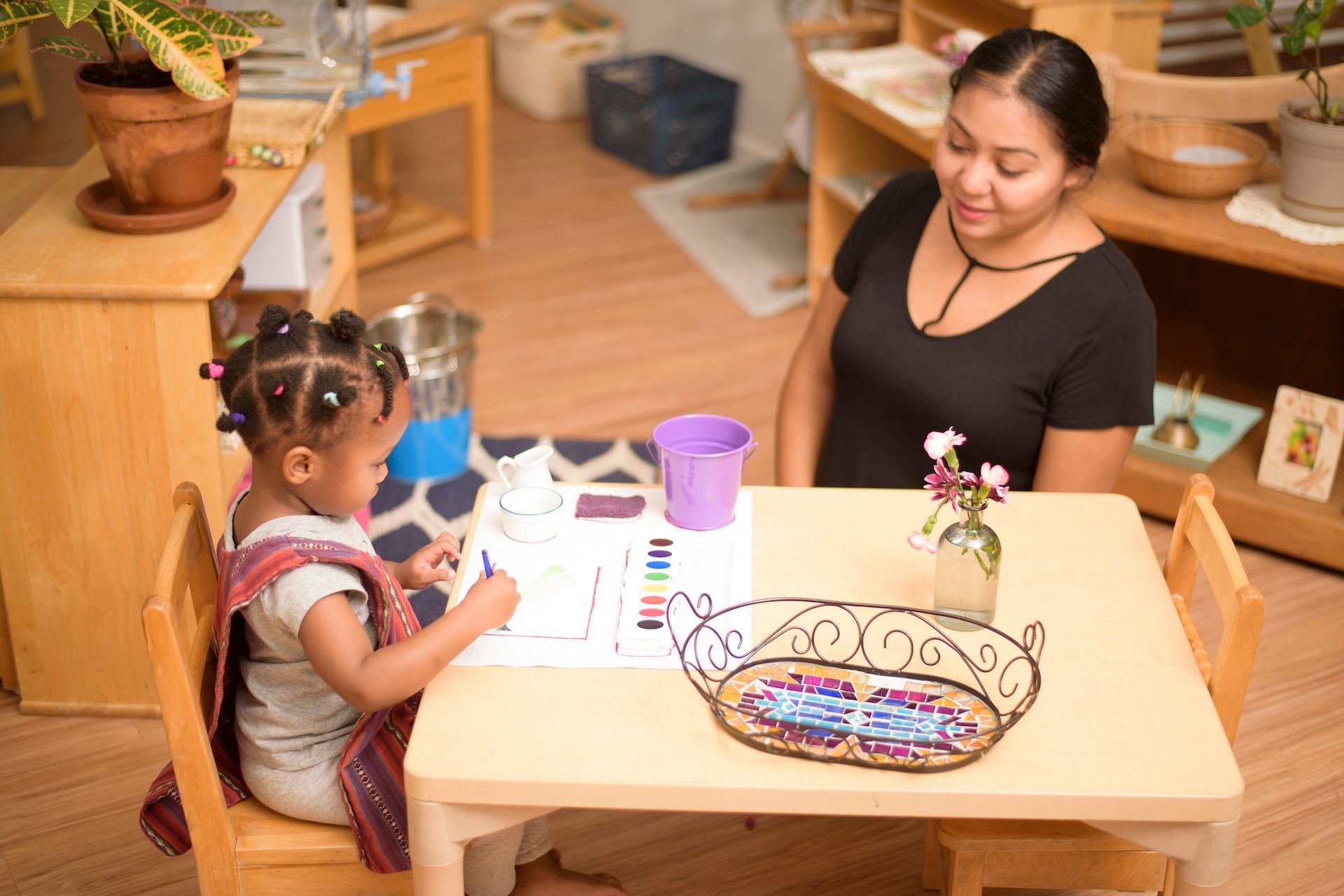
Child drawing on paper at a classroom table with art supplies and picture cards spread out.
By Gabriela León June 30, 2026
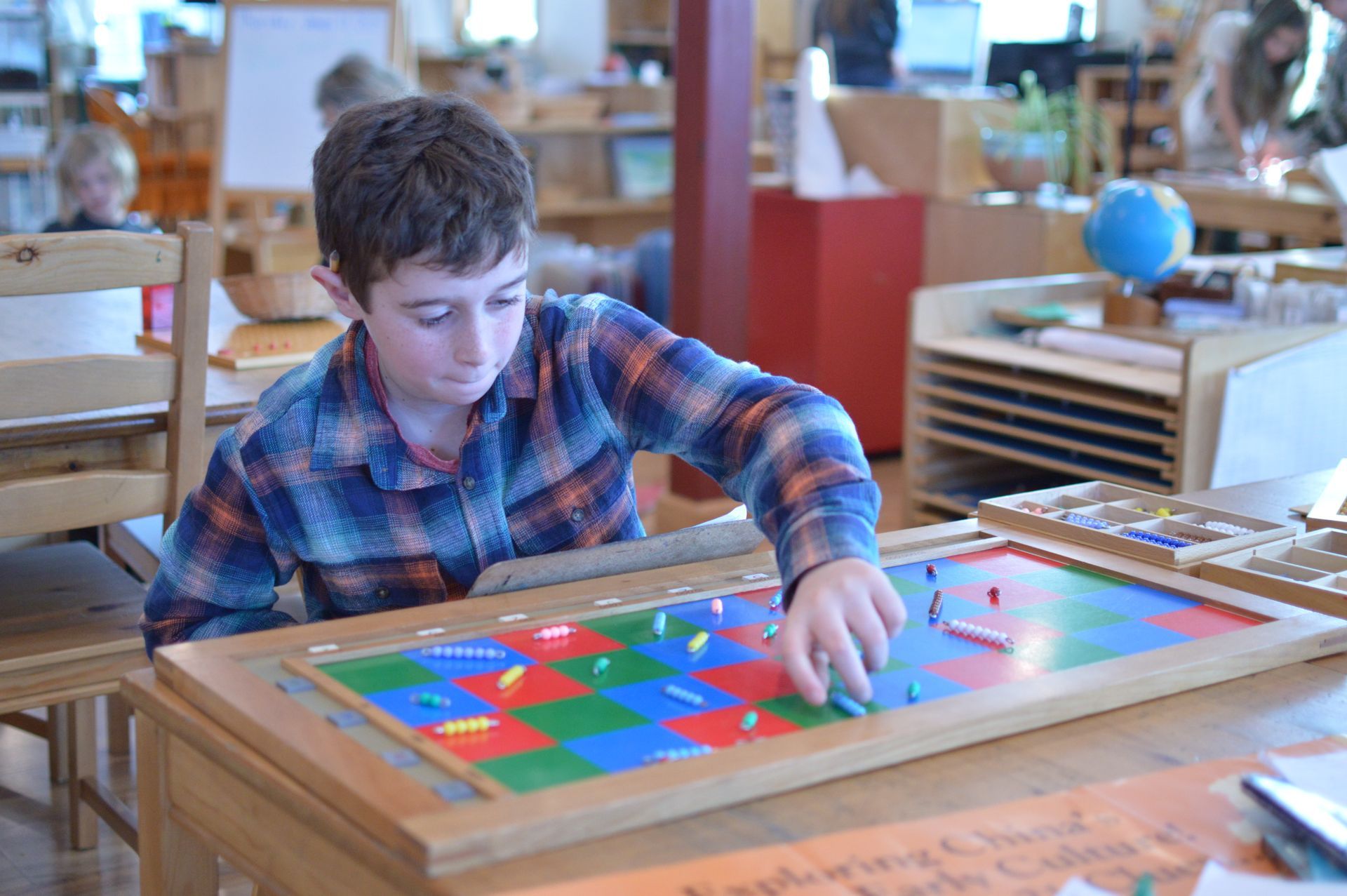
In Part One of this series, we explored Dr. Montessori's profound belief that imagination is nourished not by fantasy alone, but by reality. The richer children's concrete experiences of the world, the more powerfully their imagination can soar. In Part Two, we look at how this actually unfolds: how the carefully designed materials of the early childhood classroom lay the groundwork for the extraordinary imaginative life of the elementary-aged child. What the Youngest Children Are Really Doing Watch young children in a Montessori classroom, and you might see them tracing the edges of a triangle with their fingertips, testing objects to compare dimensions, fitting puzzle pieces of the continents together, or carefully moving golden beads that represent units, tens, hundreds, and thousands. These activities look deceptively simple. But something of tremendous importance is happening beneath the surface. These children are building the architecture of their minds. Dr. Montessori was clear about where all thinking begins: "There is nothing in the intellect which was not first in the senses." Before a child can think abstractly, before they can imagine what they cannot see, they must first have a rich, precise, embodied experience of the world around them. The sensorial materials of the Children's House are designed to provide exactly this. They train children's powers of observation, sharpen children’s ability to notice distinctions, and lay down a concrete mental structure that will serve children for the rest of their lives. Precision as the Foundation for Possibility This emphasis on precision might seem at odds with imagination, but in Montessori, it is the very source of it. As Dr. Montessori wrote in The Advanced Montessori Method, "If the true basis of the imagination is reality, and its perception is related to exactness of observation, it is necessary to prepare children to perceive the things in their environment exactly, to secure for them the material required by the imagination." In other words, the more accurately a child can see and understand the real world, the richer they can imagine beyond it. Consider geometry. When a young child explores geometric shapes and solids with their hands, by touching edges, rotating forms, and fitting pieces into matching frames, they are not simply learning shapes. They are building a sensory foundation from which, years later, they might begin to conceptualize the support structure of a bridge, understand the geometry of navigation, or envision architectural forms that don't yet exist. The hands-on work of early childhood quietly becomes the creative capacity of the older child and the adult.  The Bridge Into the Elementary Years Something significant shifts around age six. Children who spent years absorbing concrete impressions of the world now begin to hunger for something more. They want to understand not just the things in front of them, but the larger story: how those things came to be, how they connect, what lies beyond the visible horizon of their direct experience. The emergence of the reasoning mind and the explosive growth of the imagination are the hallmarks of the second plane of development. And these superpowers emerge because of everything that came before. The child who handled the golden bead material in early childhood by counting and carrying hundreds and thousands, now has the concrete foundation to comprehend something almost unfathomable: the immense passage of geological time, from the formation of the universe to the emergence of human civilization, as depicted on the Montessori timelines and clock of eras. The quantities they once held in their hands now help them grasp epochs they can never directly touch. The concrete has become a gateway to the infinite. As Dr. Montessori described it in To Educate the Human Potential: "Imaginative vision is quite different from mere perception of an object, for it has no limits. Not only can imagination travel through infinite space, but also through infinite time; we can go backwards through the epochs, and have the vision of the earth as it was, with the creatures that inhabited it." When Imagination Starts from Reality, It Can Change the World There is powerful idea running through all of this, one that reaches well beyond education into the nature of human creativity itself. When imagination is untethered from reality, it tends to stay small or drift into what Dr. Montessori called mere speculation. But when imagination is rooted in genuine understanding, something transformative becomes possible. As she wrote: "When imagination starts from contact with reality, thought begins to construct works by means of which the external world becomes transformed; almost as if the thought of man had assumed a marvelous power: the power to create." This is the arc that Montessori traces across the first 12 years of a child's life. In early childhood, we give children the real world: carefully, beautifully, precisely. In the elementary years, children take that grounded understanding and begin to reach toward the cosmic, the historical, the abstract, and the creative. One stage makes the next one possible. And the imagination that emerges is not a flight from reality, but its highest expression. What We Can Take From This The Montessori environment makes so much sense when we think about this developmental progression! The sensorial materials are not busy work. The real objects are not a rejection of play. The carefully prepared lessons are not limitations on creativity. Each of these things builds minds that are grounded, precise, and curious enough to one day imagine things the world has never seen before. Dr. Montessori always believed that the child holds the future within them. The work of the classroom (and of the family) is simply to give that future the richest possible foundation from which to grow.
Teacher reading to seated children in a bright classroom circle time
By Gabriela León June 23, 2026
Of all the aspects of Montessori philosophy that raise eyebrows, the topic of fantasy and imagination might be the most misunderstood. Parents sometimes hear that Montessori discourages imaginative play, or that it takes a dim view of fairy tales and make-believe. The reality is both more nuanced and more fascinating than that. Dr. Maria Montessori didn't distrust imagination. Actually, she revered it! She was deeply interested in understanding how imagination develops and what kinds of experiences feed it most richly. Imagination Is a Force for Truth Dr. Montessori believed that imagination is one of humanity's greatest powers. It allows us to reach beyond what is directly in front of us, to envision what we cannot see, to understand what we cannot touch, and to create what does not yet exist. It is imagination, Dr. Montessori argued, that drives scientific discovery, artistic expression, and human progress. But here is the key insight: imagination doesn't grow in a vacuum. It grows from reality. The richer and more precise children's experience of the real world, the more powerful and genuine their imaginative capacity becomes. As Dr. Montessori wrote in The Absorbent Mind, "imagination is a force for the discovery of truth," not an escape from it. For this very reason, we fill Montessori classrooms with real objects, real experiences, and real information about the world. Wonder, to be truly nourishing, needs real and wonderful things from which to emerge. The Difference Between Child-Led and Adult-Imposed Fantasy One of the most important distinctions Dr. Montessori made is the difference between fantasy that children create themselves and fantasy that adults impose on them. When young children pick up a stick and pretend it is a horse or transform a cardboard box into a spaceship, they are using their accumulated knowledge of the real world to construct a creative, imaginary one. This kind of pretend play is entirely natural and valuable. The children are in control of the fantasy, and they know, on some level, that it is fantasy. What is more complicated is when adults introduce elaborate fictions as though they were real. When we encourage children to believe things that aren’t true, we are essentially presenting misinformation to minds that are actively trying to make sense of reality. Young children in the first years of life are working hard to understand what is real and what is not. And when they are uncertain, they look to trusted adults for guidance. When those adults confirm a fantasy as reality, children's natural process of distinguishing truth from fiction is interrupted. Dr. Montessori called this state credulity: a characteristic of the immature mind that hasn't yet developed the tools to distinguish the true from the false, or the possible from the impossible. The adult's role, she believed, is not to extend credulity but to gently support children in building accurate, grounded knowledge of the world. What This Looks Like in Practice It's worth pausing here, because this aspect of Montessori philosophy can feel startling at first, especially in a culture that places enormous value on the magic of childhood and the traditions that come with it. Families navigate this in different ways, and Montessori doesn't prescribe a single approach to handling holidays or family traditions at home. What Montessori does suggest is that children are far more capable of genuine wonder than we sometimes give them credit for, and that the real world, offered to them with beauty and depth, provides more than enough magic to satisfy even the most imaginative child. Dr. Montessori gave striking examples of this. She noticed how a simple chart showing the relative sizes of the sun and the earth left young children full of astonishment, and more astonished, she observed, than any fairy tale had managed to make them. The actual scale of the universe, presented clearly and beautifully, opened something in their minds that no invented story could have reached. As she wrote in To Educate the Human Potential, by offering the story of the universe, "we give him something a thousand times more infinite and mysterious to reconstruct with his imagination, a drama no fable can reveal." Similarly, Dr. Montessori noted that children are often far more satisfied when they can engage with the real version of something rather than a pretend substitute. Washing real dishes rather than toy ones. Riding a real horse rather than a stick. Using a globe to find America rather than hearing it mentioned vaguely in conversation. The real thing, it turns out, is often more engaging, not less, than the pretend version. Reality as the Launchpad This is perhaps the most beautiful way to understand the Montessori approach to imagination. Reality is not the opposite of imagination. It is its launchpad. When children have rich, precise, hands-on experience of the world — through sensorial materials, through nature, through meaningful work, through real information about science, history, and the cosmos — their imagination has something extraordinary to work with. They can envision what they cannot see because they understand what they can. They can reach toward the abstract because they are grounded in the concrete. As Montessorian Sarah Werner Andrews described it, the development of imagination begins with children's understanding of how the real world works. And far from being an immature stage that children grow out of, this grounded imagination is "the entry into the uniquely human, lifelong capacity to imagine alternatives to reality." In other words, Montessori isn't asking children to imagine less. It is giving them everything they need to imagine more — more vividly, more truthfully, and more powerfully — for the rest of their lives. In Part Two of this series, we'll explore exactly how the early childhood materials build that foundation, and what happens to imagination when children carry it into the elementary years.