

Less Is More: The Four Things Montessori Teachers Work Hard to Not Do
Gabriela León • August 4, 2026

Learn the four practices Maria Montessori believed adults should avoid to nurture children’s independence, confidence, and self-discipline. 

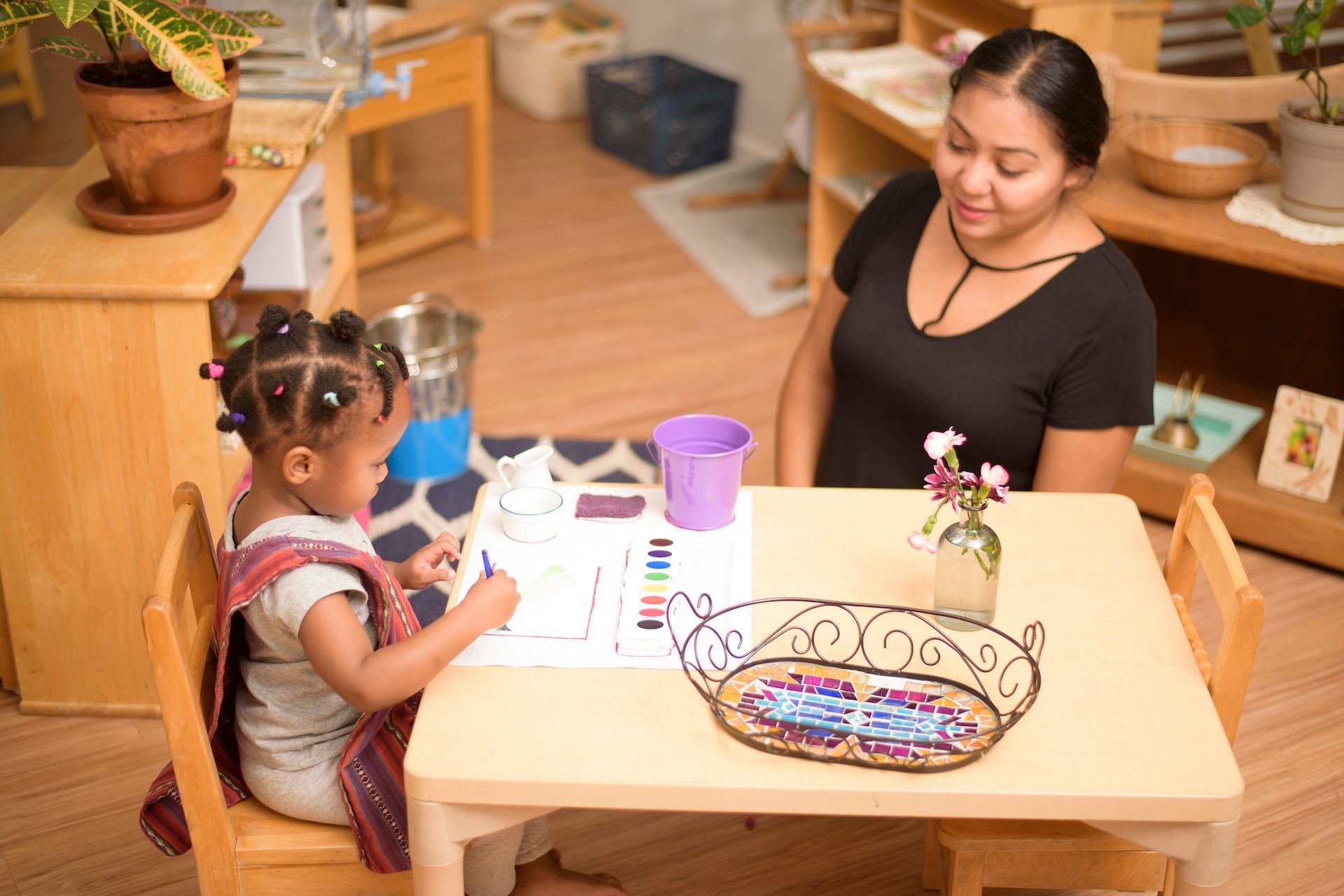
If you come to observe a Montessori classroom, you may notice that the teacher is not the center of attention. You’ll see children moving around, working on various tasks, solving problems, and helping each other, while the teacher moves quietly through the room, watching, waiting, stepping in briefly.


This is a careful, deliberate practice (and, for what it’s worth, it may be the hardest thing a Montessori teacher learns to do!).


Dr. Montessori described the ideal teacher this way: "She moves about slowly and silently. She goes up to one who has called her. Her supervision is such that anyone who needs her is immediately aware of her presence, whereas those who do not are completely oblivious of her."


To inhabit that role authentically, a Montessori teacher consciously works to avoid four practices that, however well-intentioned, ultimately hinder rather than help children's development. Those four practices are: interfering, domineering, admonishing, and serving.


The First Practice to Avoid: Interfering


Of all the habits we bring into the classroom, our impulse to interfere may be the most deeply ingrained. When children struggle, our instinct is to step in, offer the solution, and smooth the path. It takes genuine discipline to recognize that the struggle itself is often where the learning happens.


Dr. Montessori illustrated this with a simple, striking example. A teacher was about to interrupt a child who was coloring a tree trunk red, ready to ask whether the child really thought trees had red trunks. Dr. Montessori stopped her and let the child color the tree red. The child was not making a mistake to be corrected. Instead, the child was on a discovery process that adults could honor.


Children find their own solutions. They come to agreements among themselves that adults would never anticipate. When we step in to resolve what looks like a problem, we often disturb a harmony that the children were perfectly capable of finding on their own. We rob the children of the deep satisfaction that comes from figuring it out.


As Dr. Montessori observed, children who are left to manage their own challenges often "feel irritated if we intervene, and find a way if left to themselves." The teacher's role is not to prevent the problem, but to observe, to trust, and to be genuinely available only when something is beyond the child's current reach.


This requires, as Dr. Montessori acknowledged, a fundamental shift in how we as adults understand our role. We might intellectually grasp the idea, but it is genuinely difficult to embody: "This idea, that life acts of itself, and that in order to study it, to divine its secrets or to direct its activity, it is necessary to observe it and to understand it without intervening — this idea is very difficult for anyone to assimilate and to put into practice."


The Second Practice to Avoid: Domineering


Closely related to interference is domination, which is the practice of imposing our adult will, schedule, or expectations upon children’s natural developmental. In traditional educational settings, the entire structure of the day is built on a domineering framework: children are told when to start, when to stop, when to move, when to be still, what to work on, and how long to spend on it. This assembly-line structure not only interrupts concentration, it also repeatedly and implicitly communicates that children's own inner guidance cannot be trusted.


In Montessori, we take the opposite position. Our goal is not external compliance but inner discipline. This self-regulation grows from the inside out, nurtured by freedom within clear and respectful limits. As Dr. Montessori wrote with characteristic directness, "The basic error is to suppose that a person's will must necessarily be broken before it can obey." Forcing obedience does not build discipline. It builds dependence on the adult's direction to know what to do next, and on external pressure to do it.


Dr. Montessori offered an image of imposed silence and stillness as "annihilation" rather than discipline: "We do not consider an individual disciplined only when he has been rendered as artificially silent as a mute and as immovable as a paralytic. He is an individual annihilated, not disciplined." True discipline, the kind that serves children throughout life, is built through purposeful, self-directed work, not through the suppression of spontaneous activity.


The Third Practice to Avoid: Admonishing


Admonishing (the habit of correcting, scolding, and constantly drawing attention to mistakes and shortcomings) is perhaps the most common obstacle to children's inner development and, in many ways, the most counterproductive.


A useful image for thinking about this is the distinction between watering flowers and watering weeds. When adults focus their attention and energy on what children are doing wrong (marking errors, issuing reprimands, pointing out failures), we are, in effect, watering the weeds. Children’s confidence decreases. Their energy drains. Their relationship with learning becomes fraught with the anxiety of being judged.


As Dr. Montessori wrote, "To tell a child he is naughty or stupid just humiliates him; it offends and insults, but does not improve him. For if a child is to stop making mistakes, he must become more skilled, and how can he do this if, being already below standard, he is also discouraged?"


So we redirect attention from the mistake to purposeful activity. This requires that we provide an environment rich enough with interesting, meaningful work that children are naturally drawn toward growth and competence. In this sense, we don’t invoke discipline through reprimand. As Dr. Montessori explained, "The end is obtained not by attacking the mistake and fighting it, but by developing activity in spontaneous work."


What tends to emerge in this kind of environment? Children begin to admire each other's accomplishments rather than compete with them. "They admire those who do better than they do," observed Dr. Montessori. When the adult is not constantly measuring and comparing, children are freed from the need to measure and compare themselves.


The Fourth Practice to Avoid: Serving


The fourth practice (and perhaps the most surprising on this list) is serving children. Not in the sense of care and warmth, which are always appropriate, but in the sense of doing for children what they are capable of doing for themselves.


Dr. Montessori described a scene that captures this. A child was stretching and straining to see something of interest, working hard to figure out a solution. A teacher lifted the child. Problem solved, from the adult's perspective. But what had actually happened? The child's expression of "anxiety, hope, and joy,” which is the look of a person engaged in genuine effort, "was replaced by the stupid expression of a child who knows that others will act for him."


That moment of being lifted did not help the child. It taught the child that their own efforts weren’t enough and that an adult would step in. Repeated across hundreds of daily interactions, this is how capable children learn to feel incapable.


"We habitually serve children," wrote Dr. Montessori, "and this is not only an act of servility toward them, but it is dangerous, since it tends to suffocate their useful, spontaneous activity." The child who is dressed, fed, carried, and managed at every turn is denied the most important work of early childhood: building a sense of genuine competence through real effort.


This doesn't mean adults disappear. It means we calibrate our support precisely. It means we are present and available, but restrained enough to let children reach, try, struggle, and ultimately succeed on their own terms.


The Ongoing Work


Avoiding these four practices — interference, domination, admonishment, and over-serving — is genuinely difficult! These tendencies are deeply human and originate from care, good intentions, and deeply ingrained habits of how to relate to children. Dr. Montessori herself acknowledged the challenge: "Nothing is more difficult for a teacher than to give up her old habits and prejudices."


But this is precisely why the Montessori teacher's role is not passive, even when it looks that way from the outside. It requires tremendous awareness, ongoing self-reflection, and a deep faith in children's capacity to grow when given the space to do so.


And what happens when that space is genuinely protected, when we step back, trust children, and resist the well-meaning impulses to interfere, dominate, admonish, and serve? We get to see the emergence of children who know how to guide themselves, delight in their own competence, and carry an inner confidence that no gold star or correction could ever produce.


We'd love for you to observe our classroom in Peaceful Pathways and see this approach in action. Schedule a visit and see what children can do when adults learn to get out of the way!
By Gabriela León July 28, 2026
When children struggle, Montessori asks: what's in the way? Explore how the prepared environment helps children find their way back to themselves.
July 21, 2026
When most people think about what children need to thrive, they first think of the basics: food, sleep, safety, and love. Abraham Maslow described how fundamental needs (such as food, shelter, and sleep) must be met to satisfy higher spiritual needs, such as belonging, self-esteem, and self-actualization. What is perhaps less well known is that Montessori education builds on a very similar understanding of human nature and that we carefully design the prepared environment to meet not just children’s academic needs, but their deepest human ones. Dr. Maria Montessori wrote generally about human tendencies, and her son, Mario Montessori, reviewed her work to identify specific innate drives and needs shared by all of us, regardless of culture or era. These tendencies don’t change. They are part of what it means to be human. And when we give children an environment that honors and nourishes them, something remarkable happens: they begin to construct themselves from the inside out. As Christians, we also believe that children are created intentionally by God, with purpose, dignity, and unique gifts. Psalm 139 reminds us that each person is “fearfully and wonderfully made.” Children are not empty vessels waiting to be filled. They are whole human beings created in the image of God, already carrying within them the potential for growth, discovery, creativity, relationship, and wonder. The Need to Explore Every child is born with a drive to move, to discover, and to make sense of the world. This drive is a fundamental human instinct. As Dr. Montessori observed, the urge to explore isn’t simply about getting somewhere better. It is a primitive, vital impulse to engage with life. But exploration requires a foundation of security. When children’s environment is chaotic or unpredictable, they must constantly spend their energy simply reorienting themselves. Constant reorientation means they are expending energy on figuring out what’s where and what comes next, rather than on curious, joyful discovery. This is why we design Montessori classrooms with such deep intentionality. Materials are always in their place. The order is consistent and reliable. Within this predictable structure, children feel safe enough to truly explore, and through that exploration, they begin to develop an internal order that mirrors the order around them. Scripture reminds us that “God is not a God of disorder but of peace” (1 Corinthians 14:33). Children flourish in environments marked by peace, consistency, beauty, and purpose. In many ways, the prepared Montessori environment reflects these truths. It provides children with the freedom to explore within clear and thoughtful boundaries, helping them grow in confidence, independence, and responsibility. We also believe that creation itself invites exploration. Whether children are observing insects outdoors, arranging flowers, tracing land and water forms, or caring for plants and animals, they are engaging with a world created by God with beauty and intentionality. The Need to Work Humans learn by doing. Think of the words of Confucius: I hear and I forget. I see and I remember. I do and I understand. Throughout history, purposeful human work has created civilizations, driven innovation, and provided individuals with a profound sense of meaning and self-worth. Children have this need for meaningful activity within them. They want to work in real ways! Woven into this human tendency for work is a cluster of connected needs: the need for activity, for manipulation, for repetition, for exactness, and for self-perfection. Montessori materials are designed to honor all of these. They are hands-on, precise, and designed to be worked with again and again. Each time a child repeats an activity, such as pouring water carefully, sorting objects, tracing the shapes of letters, they are integrating mind and body, learning from their mistakes, and moving toward a more perfected version of themselves. They absorb complex concepts through experience, repeated freely and with deep engagement. In a Montessori classroom, children are given opportunities to contribute meaningfully to their environment. They wash tables, prepare snack, sweep floors, care for classroom materials, help younger children, and take responsibility for their community. These activities are not busy work. They help children develop concentration, coordination, confidence, and independence. The Bible also speaks to the goodness and dignity of purposeful work. Colossians 3:23 tells us, “Whatever you do, work heartily, as for the Lord.” Even young children long to know that what they do matters. When children are trusted with meaningful responsibilities, they begin to see themselves as capable contributors rather than passive participants. The Mathematical Mind Humans have an innate drive to measure, classify, organize, and make sense of the world in precise ways. Dr. Montessori was inspired by the philosopher Pascal, who wrote that the human mind is mathematical by nature. Knowledge and progress come from accurate observation. Dr. Montessori called this the mathematical mind. And she saw it not as an academic aptitude but as a fundamental human characteristic. The Montessori sensorial materials are designed with this tendency in mind. Think of the pink tower, color tablets, or geometric solids. When children work with these materials, they are training their powers of observation and building the precise mental framework from which abstract thinking and imagination will eventually grow. As Dr. Montessori wrote, if the true basis of imagination is reality, then helping children perceive the world with accuracy is one of the greatest gifts we can give them. Christians have long viewed the order and beauty of the universe as evidence of a thoughtful Creator. From patterns in nature to mathematical relationships, the world reflects consistency, design, and structure. As children engage with Montessori materials, they are not only developing academic understanding. They are learning to observe carefully, think logically, and appreciate the beauty and order woven throughout creation. The Need to Belong As children engage deeply with meaningful work in the Montessori environment, something shifts. They become more focused. More settled. More themselves. And from this state of inner calm, children begin to experience a natural orientation toward others. This is deeply human. The drive to communicate, to belong, to understand ourselves in relation to a community, has shaped human civilization from its earliest days. Montessori classrooms are like small, practice societies: mixed-age communities where children learn to work alongside one another, contribute, notice others’ needs, and think not only about their own success but also about the well-being of the group. As Dr. Montessori stated, “social integration has occurred when the individual identifies himself with the group to which he belongs.” Individual interests and communal ones begin to align. We don’t teach this awareness of community through rules or enforce it through compliance. It develops organically when we give children ideal conditions to grow into it. Scripture teaches us that we were created for relationship — both with God and with one another. In Galatians 6:2, we are reminded to “carry each other’s burdens,” and in Philippians 2:4 we are encouraged to look not only to our own interests but also to the interests of others. In the Montessori classroom, children practice these principles daily in tangible ways: waiting patiently, helping a younger friend, speaking kindly, resolving conflict peacefully, and learning to function as part of a caring community. The Spiritual Dimension And then there is something deeper still. Something that is harder to name, but unmistakable when you see it. Humans have always sought meaning beyond themselves. Through art, music, ritual, and community, we reach toward something greater, toward beauty, transcendence, and a sense of connection with life itself. This spiritual dimension of human experience is not reserved for adults. Children feel it too. Dr. Montessori used music to describe this tendency. Music is exact and beautiful, and when it truly reaches a person, it moves them, literally and figuratively. Something is set in motion, deep inside. Dr. Montessori then drew a direct parallel to what happens when children encounter an activity that genuinely engages them. When children feel and understand something that arouses their interest, they begin to move. Their movements connect to the work. Gradually, a unity develops in their personality. They repeat the activity with deep concentration. And when they finish, they seem different: happier, more satisfied, calmer, more at rest. Something elevates within them. This transformation is at the heart of what Montessori education is reaching toward. The classroom is not simply a place where children learn to read and count. It is a place where children are recognized as spiritual beings, where their souls, not just their minds, flourish through movement, engagement, beauty, and understanding. As a Christian Montessori school, we believe children are created not only with intellectual and physical needs, but spiritual ones as well. Jesus welcomed children with tenderness and value, saying, “Let the little children come to me” (Matthew 19:14). We believe children possess a natural sense of wonder, awe, and connection to God’s creation. Quiet moments of concentration, gratitude, beauty, nature, music, prayer, and peaceful community all help nurture that spiritual life. What This Means for Families Mario Montessori wrote that every child is born with human tendencies as potentialities, and that children make use of them to build themselves into a person suited to their time. What the Montessori environment does is provide the conditions in which those tendencies can be met, honored, and developed to their fullest expression. When we nourish children’s needs for exploration, work, mathematical thinking, belonging, and spiritual engagement, they become capable learners and, perhaps even more importantly, whole people who are curious, grounded, socially aware, and at peace with themselves and the world. At Peaceful Pathways Montessori, we believe education is about more than academics alone. It is about helping children grow into thoughtful, capable, compassionate individuals who understand both their responsibility to others and their value as children of God. And that, as Dr. Montessori always believed, is the foundation for individual flourishing and of a more peaceful society for all of us.