


Tattling vs. Telling: A Montessori Approach
April 11, 2025

How often have our little ones run up to us to spill forth their grievances about other children? Sometimes, these reports are about broken rules. Sometimes, they are about hurt feelings. Sometimes, they may even be attempts to get others “in trouble.” 


In these moments, we have a split second to determine how best to respond. And our response matters!


Underlying Issues


When children come to an adult to tattle, typically they are trying to figure out the rules, both explicit and implicit, as well as how those rules are enforced. Which rules are critical? Which rules can be bent or broken? When should someone intervene?


Although those “tattle” moments can feel annoying, it can help to remember that there are probably a dozen or more other times when they didn't come to an adult. Coming for help can be because they reached the point of enough is enough. In this case, the "tattling" is really a plea for help.


We can remember that children are in the process of creating their value system, and this is especially so for elementary-aged children who have a heightened sense of justice and are often acutely attuned to what is or isn’t fair.


Children who are regularly tattling, are usually those who need support with figuring out the intricacies of rules and which are the most important. Children who have clarity about this are more likely to just remind a sibling or classmate about the rule.


If we reframe how we think about a tattler, we can see that child as asking for affirmation or clarification, or even just a clear understanding of the consequences of breaking a rule. 


Reframing Our Response


If we reframe tattling as a request for help, our response can shift accordingly: "It sounds like you really need some help with this. What can I do to help?" Or "I hear that you are feeling very frustrated with Jackie. Let's go talk to her.”


It’s important that we don’t just dismiss children by telling them to go work it out on their own. The reason they have come to you is for some help. 


That being said, if children are seeking retribution or punishment for another, we have a good opportunity to help guide them through another approach. Maybe the two children aren't getting along for some reason and they need some support to repair their relationship.


A Step-by-Step Approach


  • First, take a moment to try to determine the intention behind the tattling. One way to slow down the process is to make an observation and restate the concern: “So you are upset that…” or “You are concerned about…” 


  • We also want to acknowledge children’s feelings and need for help: “Theo, it sounds like you need some help resolving this with Tristan. Let’s go talk to him together.”


  • We can then facilitate a structured conversation between the children. For the most success, we want to ensure the conversation happens in a calm, neutral setting. Then we can encourage each child to express their concerns: “Theo, can you explain to Tristan what happened that upset you?”


  • It helps to remind both children to truly listen to each other and to ask the listener to repeat what they heard in their own words: “Tristan, what did you hear Theo say?”


  • In this process, we can help explore the root of the issue and see if there were any triggers that led to the unwanted behavior: “So I wonder what happened prior to Tristan throwing a stick at you. What could have caused him to want to do that?”


  • It’s important to allow both children to express their perspectives and repeat back what they heard.


  • We can also encourage the children to think critically about their motivations to guide everyone toward a resolution. Try questions like: 


  1. “What do you think I should do here?” 
  2. “What do you think should happen next?”
  3. “What would help resolve this?”


In asking these kinds of questions, we are helping children consider their own motivations as well as how to make amends. This can help bring to light if they are seeking punishment or truly need help resolving the issue.


Children are also very sensitive to whether we are maintaining adult neutrality. Even if one child seems “more guilty,” we want to avoid taking sides so that the process is focused on understanding, communication, and relationship repair.


Helping Children Distinguish Between Tattling and Telling


Over time, we ultimately want children to build the skills to independently resolve conflicts, uphold expectations, and know when to get help for serious issues. As children develop trust in the fact that adults can be counted on to help as they form their own value systems, we can introduce them to the difference between tattling and telling. 


What is Telling?

Reporting serious concerns (safety, harm, or bullying).

Seeking help when there is a genuine need for an adult’s intervention.

Example: “Someone is hurt,” or “I saw something dangerous.”


What is Tattling?

Seeking attention.

Trying to get someone in trouble.

Reporting minor issues that could be resolved independently.

Example: “She took my pencil!”


Feel free to download this visual guide to use as a discussion tool with children. It’s important to acknowledge that children often struggle to distinguish between tattling and telling. But with support, time, and intentionality, children can learn! They may even want to add to the list as they experience different instances of tattling or telling.


We want children to learn that safety and well-being are priorities while also empowering them to be able to problem-solve when issues arise. The goal is for children to recognize when an issue requires an adult’s help and how they can take responsibility in social situations. As adults, we can model empathy and accountability in this process. 


We also invite you to visit our school to see Montessori conflict resolution strategies in action!
By Gabriela León July 7, 2026
Montessori geography materials help children explore the world through hands-on learning, imagination, and real-world discovery.
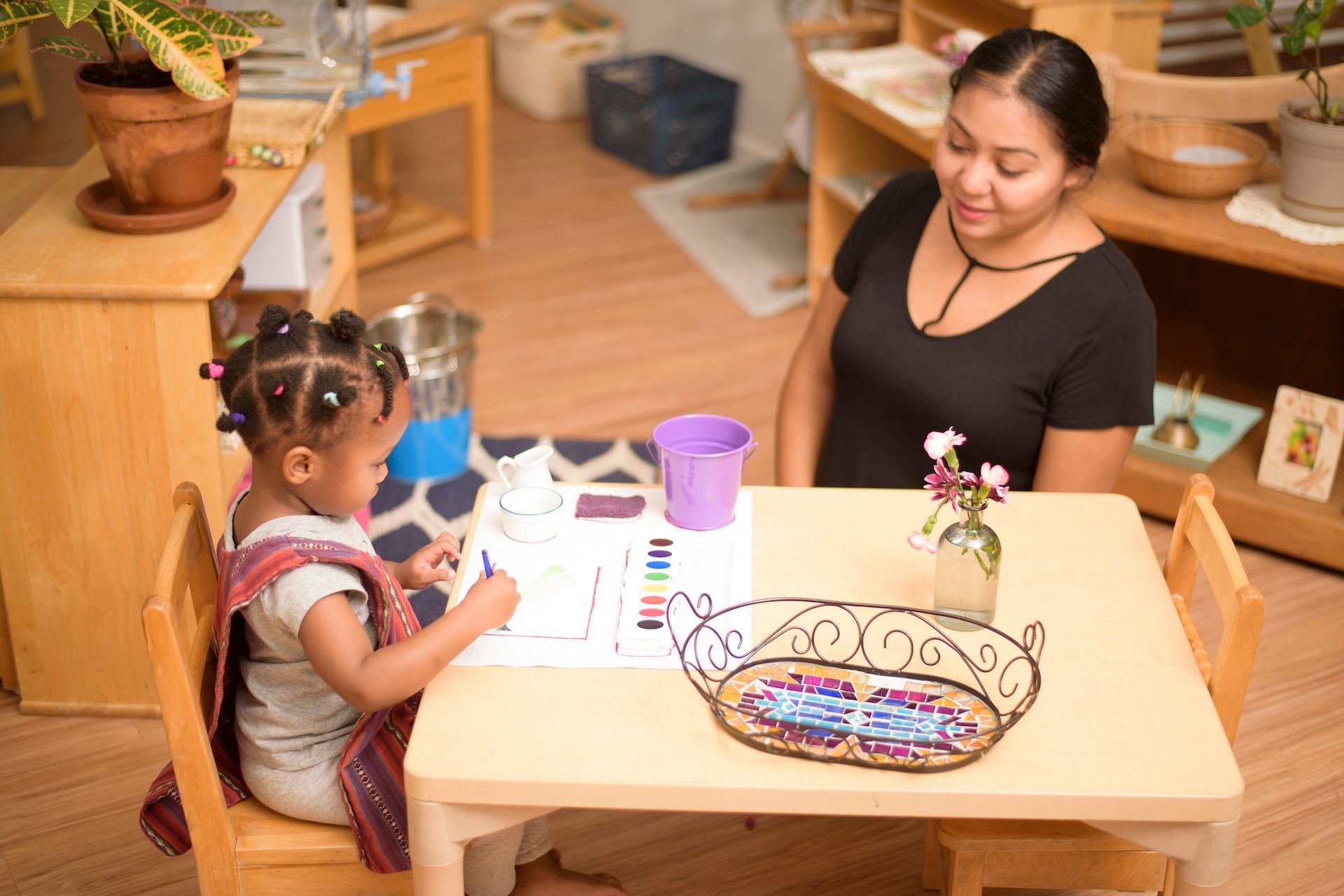
Child drawing on paper at a classroom table with art supplies and picture cards spread out.
By Gabriela León June 30, 2026
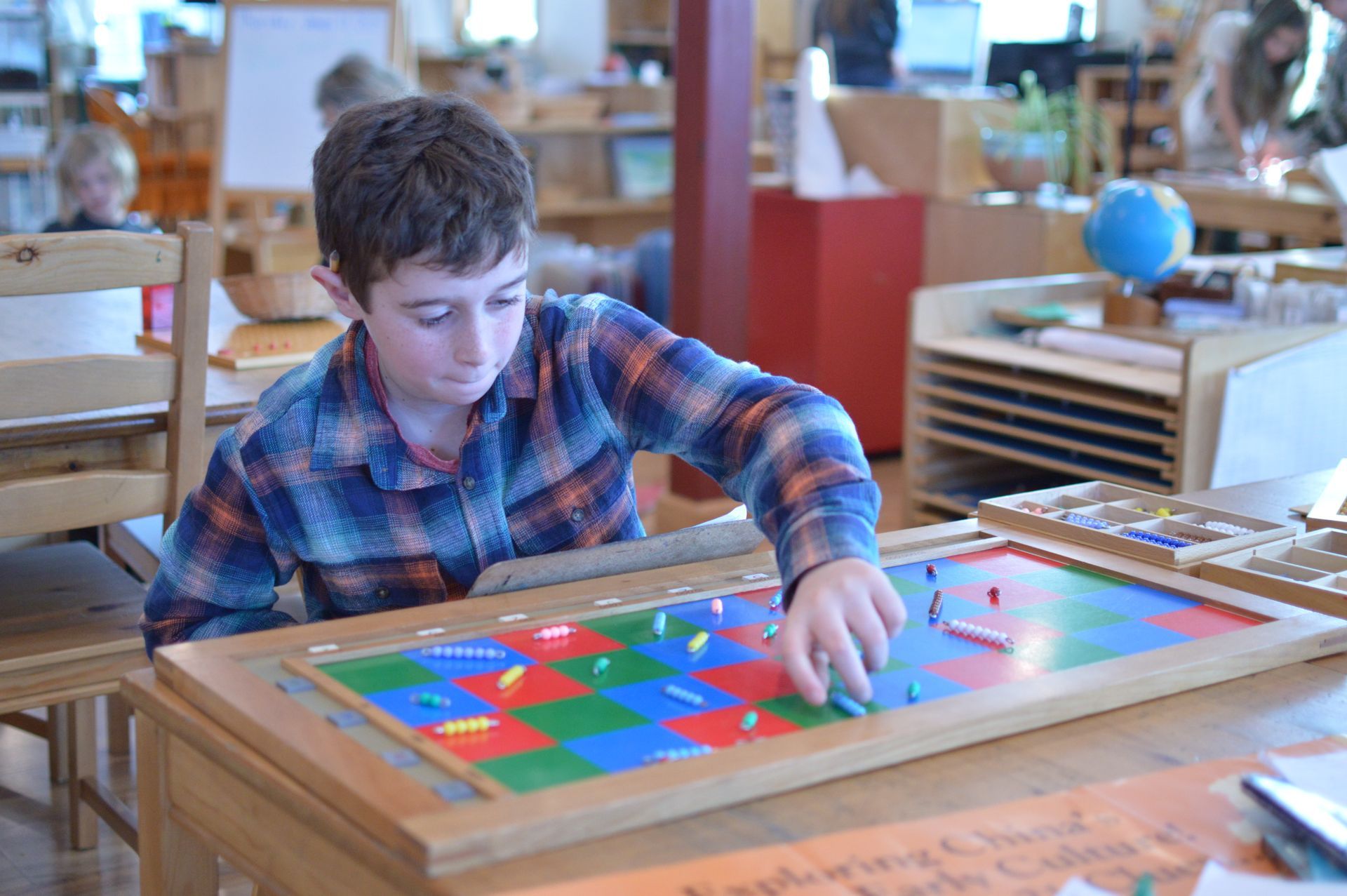
In Part One of this series, we explored Dr. Montessori's profound belief that imagination is nourished not by fantasy alone, but by reality. The richer children's concrete experiences of the world, the more powerfully their imagination can soar. In Part Two, we look at how this actually unfolds: how the carefully designed materials of the early childhood classroom lay the groundwork for the extraordinary imaginative life of the elementary-aged child. What the Youngest Children Are Really Doing Watch young children in a Montessori classroom, and you might see them tracing the edges of a triangle with their fingertips, testing objects to compare dimensions, fitting puzzle pieces of the continents together, or carefully moving golden beads that represent units, tens, hundreds, and thousands. These activities look deceptively simple. But something of tremendous importance is happening beneath the surface. These children are building the architecture of their minds. Dr. Montessori was clear about where all thinking begins: "There is nothing in the intellect which was not first in the senses." Before a child can think abstractly, before they can imagine what they cannot see, they must first have a rich, precise, embodied experience of the world around them. The sensorial materials of the Children's House are designed to provide exactly this. They train children's powers of observation, sharpen children’s ability to notice distinctions, and lay down a concrete mental structure that will serve children for the rest of their lives. Precision as the Foundation for Possibility This emphasis on precision might seem at odds with imagination, but in Montessori, it is the very source of it. As Dr. Montessori wrote in The Advanced Montessori Method, "If the true basis of the imagination is reality, and its perception is related to exactness of observation, it is necessary to prepare children to perceive the things in their environment exactly, to secure for them the material required by the imagination." In other words, the more accurately a child can see and understand the real world, the richer they can imagine beyond it. Consider geometry. When a young child explores geometric shapes and solids with their hands, by touching edges, rotating forms, and fitting pieces into matching frames, they are not simply learning shapes. They are building a sensory foundation from which, years later, they might begin to conceptualize the support structure of a bridge, understand the geometry of navigation, or envision architectural forms that don't yet exist. The hands-on work of early childhood quietly becomes the creative capacity of the older child and the adult.  The Bridge Into the Elementary Years Something significant shifts around age six. Children who spent years absorbing concrete impressions of the world now begin to hunger for something more. They want to understand not just the things in front of them, but the larger story: how those things came to be, how they connect, what lies beyond the visible horizon of their direct experience. The emergence of the reasoning mind and the explosive growth of the imagination are the hallmarks of the second plane of development. And these superpowers emerge because of everything that came before. The child who handled the golden bead material in early childhood by counting and carrying hundreds and thousands, now has the concrete foundation to comprehend something almost unfathomable: the immense passage of geological time, from the formation of the universe to the emergence of human civilization, as depicted on the Montessori timelines and clock of eras. The quantities they once held in their hands now help them grasp epochs they can never directly touch. The concrete has become a gateway to the infinite. As Dr. Montessori described it in To Educate the Human Potential: "Imaginative vision is quite different from mere perception of an object, for it has no limits. Not only can imagination travel through infinite space, but also through infinite time; we can go backwards through the epochs, and have the vision of the earth as it was, with the creatures that inhabited it." When Imagination Starts from Reality, It Can Change the World There is powerful idea running through all of this, one that reaches well beyond education into the nature of human creativity itself. When imagination is untethered from reality, it tends to stay small or drift into what Dr. Montessori called mere speculation. But when imagination is rooted in genuine understanding, something transformative becomes possible. As she wrote: "When imagination starts from contact with reality, thought begins to construct works by means of which the external world becomes transformed; almost as if the thought of man had assumed a marvelous power: the power to create." This is the arc that Montessori traces across the first 12 years of a child's life. In early childhood, we give children the real world: carefully, beautifully, precisely. In the elementary years, children take that grounded understanding and begin to reach toward the cosmic, the historical, the abstract, and the creative. One stage makes the next one possible. And the imagination that emerges is not a flight from reality, but its highest expression. What We Can Take From This The Montessori environment makes so much sense when we think about this developmental progression! The sensorial materials are not busy work. The real objects are not a rejection of play. The carefully prepared lessons are not limitations on creativity. Each of these things builds minds that are grounded, precise, and curious enough to one day imagine things the world has never seen before. Dr. Montessori always believed that the child holds the future within them. The work of the classroom (and of the family) is simply to give that future the richest possible foundation from which to grow.