
Where Learning Grows: The Montessori Approach to Outdoors
August 19, 2025

One of the many beautiful and empowering aspects of Montessori education is how it helps children understand themselves as valued members of a community. A key way this happens is through Care of the Environment, a form of Practical Life work that provides children with the opportunity to tend to the spaces they live in each day. 


By participating in this care, children begin to feel at home in their classroom, school, and community. They feel a sense of ownership and take pride in their surroundings, and in the process, develop a deep sense of responsibility and connection.


The Outdoor Environment


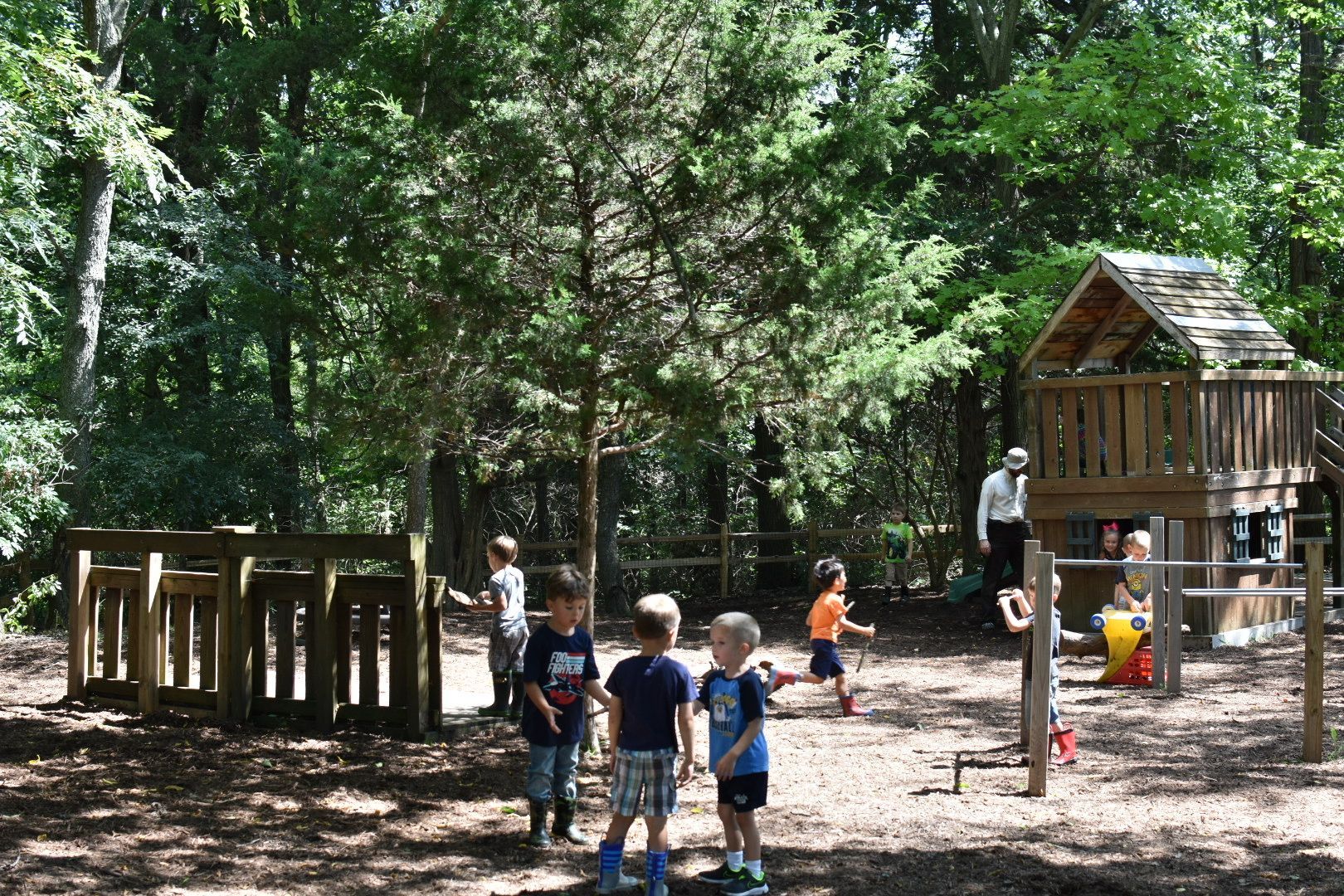
When considering the children’s environment, we're not just referring to indoor spaces. In Montessori, the outdoor environment is not an afterthought. Instead, we consider the outdoors to be a natural and essential extension of the prepared indoor space. 


For young children, who are absorbing everything from the world around them, the time spent outdoors supports development in profound and lasting ways. For older children and adolescents, outdoor spaces can be a place for self-regulation and deep focus. 


Now more than ever, when children tend to spend increasing amounts of time indoors, reconnecting with natural spaces is vital for physical, emotional, and cognitive health.


Why Being Outdoors Matters


Research, including the work of Richard Louv in The Last Child in the Woods, highlights a growing body of evidence that time spent in nature is critical to the healthy development of both children and adults. In Montessori, we recognize that outdoor time is not a break from learning. Rather, the natural world is a powerful space for movement, language, social development, and sensory integration. Time outdoors is learning time. 


Young children are in the midst of sensitive periods for order, language, movement, and sensory refinement. These windows of opportunity allow for an intense connection with nature that nourishes the whole child. Plus, the natural world’s beauty, order, and rhythm speak to our deepest human tendencies: to explore, understand, and belong.


The Adults’ Role Outside


Outdoor spaces become a rich environment for observation, guidance, and connection. Children are often more socially expressive outdoors, making this a critical time for observing group dynamics and supporting social-emotional growth.


It’s also a time to model joyful, playful behavior. Children need to see that being human includes lightness and laughter, and outdoor time offers the perfect opportunity for us to play alongside children while still maintaining an appropriate level of guidance.


We can also help children understand that different environments call for different behaviors. What is appropriate outdoors differs from what is expected indoors. As children gain different experiences, they come to understand how to conduct themselves with grace and courtesy on a woodland trail and a garden bed, or how to navigate the intricacies of fort building and group game dynamics. Montessori children learn to move through different scenes and scenarios with increasing awareness, sensitivity, and confidence.


Setting Up Outdoor Spaces


We want our outdoor spaces to feel like a true extension of our classrooms, not a break from them. As such, we are intentional about how the outdoor spaces are developmentally appropriate, deepen children’s understanding of cause and effect, and nurture a sense of order. We want activities in the outdoor space to have a purposeful intent so they support the integration of children’s will, intellect, and coordinated movement. 


At home, outdoor activities can provide open-ended play opportunities that encourage exploration and independence, as well as ways to involve children in purposeful projects. Here are some ideas to get started!


Practical Life


  • Provide tools for cleaning tasks: sweeping paths, washing outdoor furniture, scrubbing flower pots, washing the car, and wiping off outdoor toys.
  • Encourage gardening: planting seeds, watering, weeding, harvesting herbs or vegetables.
  • Offer animal care opportunities: refilling bird feeders, walking the dog, playing fetch.


Sensorial Exploration


  • Include sensory gardens with fragrant herbs, soft leaves, and vibrant flowers—like lavender, mint, and lamb’s ear—that invite children to touch, smell, and observe.
  • Create a collection space for sticks, stones, pinecones, shells, and seed pods.


Gross Motor Development


  • Find natural structures like logs or balance beams for climbing.
  • Encourage running, rolling, or playing games in grassy areas.
  • Create sand or dirt pits for digging and building.


Observation and Nature Study


  • Set up bird feeders, weather tools, and insect hotels. 
  • Create small areas for quiet observation with a bench, blanket, or hammock.
  • Add sensory elements like wind chimes or water features to create a calming atmosphere.


Curricular Connections


  • Math: count petals, measure plant growth, sort leaves by size and shape.
  • Science: Tools like magnifying glasses and microscopes help them explore soil, insects, and plant life up close. Composting systems, rainwater collection, or native plantings foster environmental stewardship.
  • Art: Natural materials become mediums for creativity, such as twigs for weaving, leaves for prints, and landscapes for sketching.
  • Language: Storytelling, reading under a tree, or labeling plants and garden tools strengthens vocabulary and communication while keeping learning grounded in the real world.


Observe and Adapt


As with all prepared environments, the key is observation. What captures our children’s curiosity? Where are they returning again and again? What challenges are they facing?


By observing carefully, we can adjust to our children’s needs and interests. A prepared environment supports the whole child and helps them feel connected, not just to the earth, but to themselves and their community. 

By Gabriela León July 7, 2026
Montessori geography materials help children explore the world through hands-on learning, imagination, and real-world discovery.
Child drawing on paper at a classroom table with art supplies and picture cards spread out.
By Gabriela León June 30, 2026
In Part One of this series, we explored Dr. Montessori's profound belief that imagination is nourished not by fantasy alone, but by reality. The richer children's concrete experiences of the world, the more powerfully their imagination can soar. In Part Two, we look at how this actually unfolds: how the carefully designed materials of the early childhood classroom lay the groundwork for the extraordinary imaginative life of the elementary-aged child. What the Youngest Children Are Really Doing Watch young children in a Montessori classroom, and you might see them tracing the edges of a triangle with their fingertips, testing objects to compare dimensions, fitting puzzle pieces of the continents together, or carefully moving golden beads that represent units, tens, hundreds, and thousands. These activities look deceptively simple. But something of tremendous importance is happening beneath the surface. These children are building the architecture of their minds. Dr. Montessori was clear about where all thinking begins: "There is nothing in the intellect which was not first in the senses." Before a child can think abstractly, before they can imagine what they cannot see, they must first have a rich, precise, embodied experience of the world around them. The sensorial materials of the Children's House are designed to provide exactly this. They train children's powers of observation, sharpen children’s ability to notice distinctions, and lay down a concrete mental structure that will serve children for the rest of their lives. Precision as the Foundation for Possibility This emphasis on precision might seem at odds with imagination, but in Montessori, it is the very source of it. As Dr. Montessori wrote in The Advanced Montessori Method, "If the true basis of the imagination is reality, and its perception is related to exactness of observation, it is necessary to prepare children to perceive the things in their environment exactly, to secure for them the material required by the imagination." In other words, the more accurately a child can see and understand the real world, the richer they can imagine beyond it. Consider geometry. When a young child explores geometric shapes and solids with their hands, by touching edges, rotating forms, and fitting pieces into matching frames, they are not simply learning shapes. They are building a sensory foundation from which, years later, they might begin to conceptualize the support structure of a bridge, understand the geometry of navigation, or envision architectural forms that don't yet exist. The hands-on work of early childhood quietly becomes the creative capacity of the older child and the adult.  The Bridge Into the Elementary Years Something significant shifts around age six. Children who spent years absorbing concrete impressions of the world now begin to hunger for something more. They want to understand not just the things in front of them, but the larger story: how those things came to be, how they connect, what lies beyond the visible horizon of their direct experience. The emergence of the reasoning mind and the explosive growth of the imagination are the hallmarks of the second plane of development. And these superpowers emerge because of everything that came before. The child who handled the golden bead material in early childhood by counting and carrying hundreds and thousands, now has the concrete foundation to comprehend something almost unfathomable: the immense passage of geological time, from the formation of the universe to the emergence of human civilization, as depicted on the Montessori timelines and clock of eras. The quantities they once held in their hands now help them grasp epochs they can never directly touch. The concrete has become a gateway to the infinite. As Dr. Montessori described it in To Educate the Human Potential: "Imaginative vision is quite different from mere perception of an object, for it has no limits. Not only can imagination travel through infinite space, but also through infinite time; we can go backwards through the epochs, and have the vision of the earth as it was, with the creatures that inhabited it." When Imagination Starts from Reality, It Can Change the World There is powerful idea running through all of this, one that reaches well beyond education into the nature of human creativity itself. When imagination is untethered from reality, it tends to stay small or drift into what Dr. Montessori called mere speculation. But when imagination is rooted in genuine understanding, something transformative becomes possible. As she wrote: "When imagination starts from contact with reality, thought begins to construct works by means of which the external world becomes transformed; almost as if the thought of man had assumed a marvelous power: the power to create." This is the arc that Montessori traces across the first 12 years of a child's life. In early childhood, we give children the real world: carefully, beautifully, precisely. In the elementary years, children take that grounded understanding and begin to reach toward the cosmic, the historical, the abstract, and the creative. One stage makes the next one possible. And the imagination that emerges is not a flight from reality, but its highest expression. What We Can Take From This The Montessori environment makes so much sense when we think about this developmental progression! The sensorial materials are not busy work. The real objects are not a rejection of play. The carefully prepared lessons are not limitations on creativity. Each of these things builds minds that are grounded, precise, and curious enough to one day imagine things the world has never seen before. Dr. Montessori always believed that the child holds the future within them. The work of the classroom (and of the family) is simply to give that future the richest possible foundation from which to grow.